

RuneReader's Story


Although I’ve created an app and shared ways to use runes, I don't think I'm an expert on runes or runic divination. Rather, RuneReader was born through my journey of learning runes.
I started studying runes intently in 2023. As someone who struggles with languages and symbology, runes did not come easily to me. It took me an embarrassingly long time to recognize Fehu from Ansuz on sight. (Algiz and Tiwaz still trip me up sometimes.) I found myself wishing for flash cards to more easily drill the forms and meanings of the runes.
RuneReader's single rune draw function was born from those flash cards.
My original, hand-drawn flash cards RuneReader's single rune draw feature
I made my own flash cards and slowly learned to work with these rich, meaningful tools. I found a set of runes I could work with and started practicing doing divinations with them. I would do three-rune draws side by side with my tarot deck to help me calibrate my skills. The overlap between tools may be due to the reader, but it did wonders to build my confidence working with runes.
That go-to three-rune layout became the three-rune draw in RuneReader. I'm particularly fond of it, as it links in a bit of the history of the Elder Futhark by using the Norns to signify each rune's place in the reading.

When I started learning more about vitki and full rune castings, the first thing I thought about was how I could code that functionality. It was here, in late 2024, that the idea of RuneReader as an app was actually born.
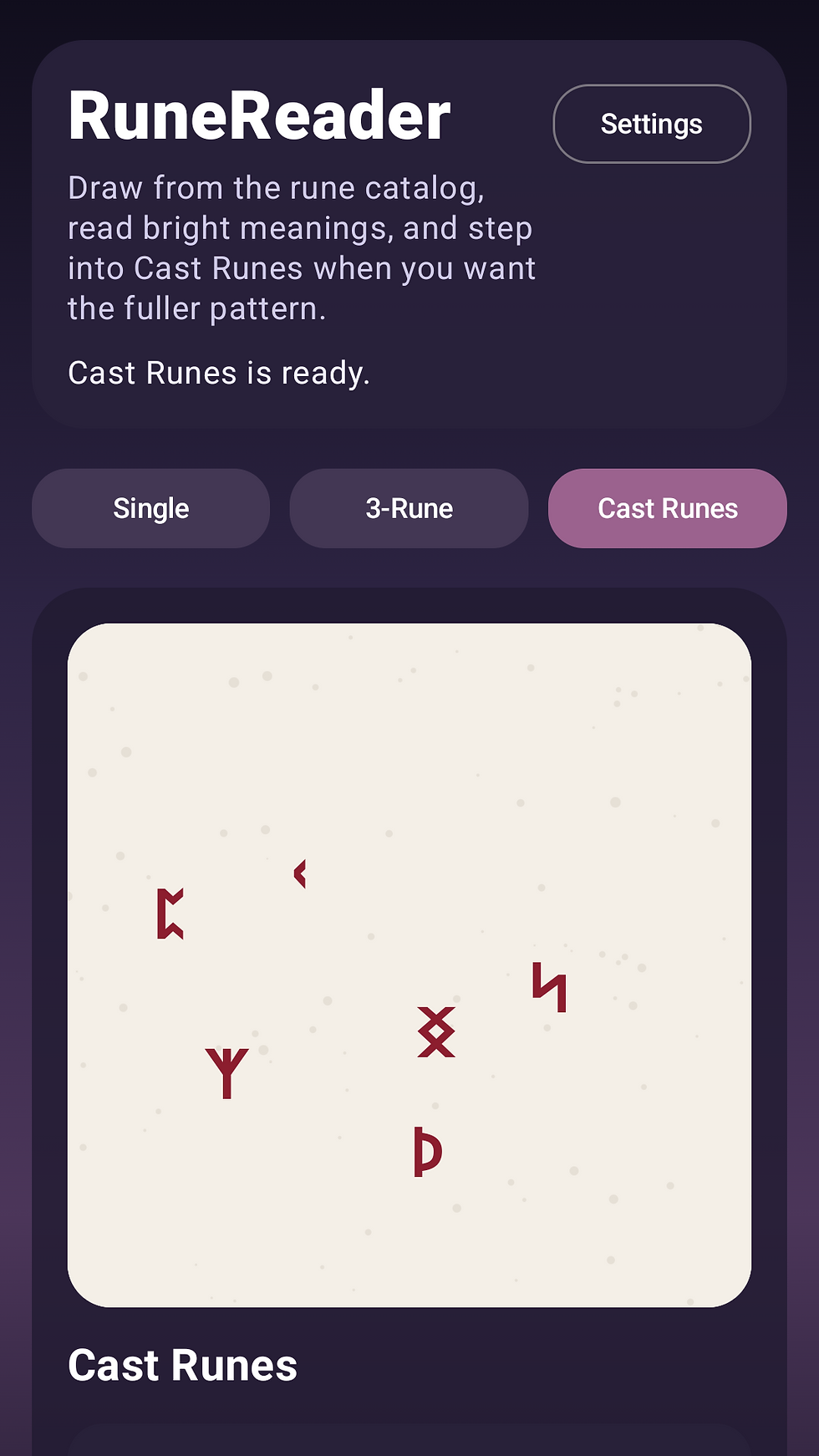
As an IT professional, I knew it could be done, but it would require expanding my coding skillset. But, like everyone, I had a full life, so building the app sat on the shelf of dreams deferred until the beginning of 2026.
I'm the first person to own up to the fact that I use AI and I used it specifically in developing RuneReader. Like most people, my employer is looking at integrating AI in our company and, since it would be unavoidable, I wanted to experiment with it to see how I could best leverage this tool in the workplace. That experimentation evolved into RuneReader.
The biggest roadblock to coding RuneReader myself was time. The second was that the programming languages I was proficient in were not ones that lent themselves well to app development. Using AI to do the coding while I focused on functionality let me iterate through the development process quickly. I also made sure that the pieces that made RuneReader valuable, the runes and meanings, were from my studies and not from AI's research.
While there are serious ethical concerns around AI, its usage, and its environmental impact, RuneReader would not exist today without it. And, I'm comfortable with my usage of AI at this time.
RuneReader reflects my journey in learning runes, the tools I yearned for along that journey, and the ones I'm excited about now.
I hope RuneReader becomes a meaningful tool in your journey with runes, just as it has been in mine.
Comments